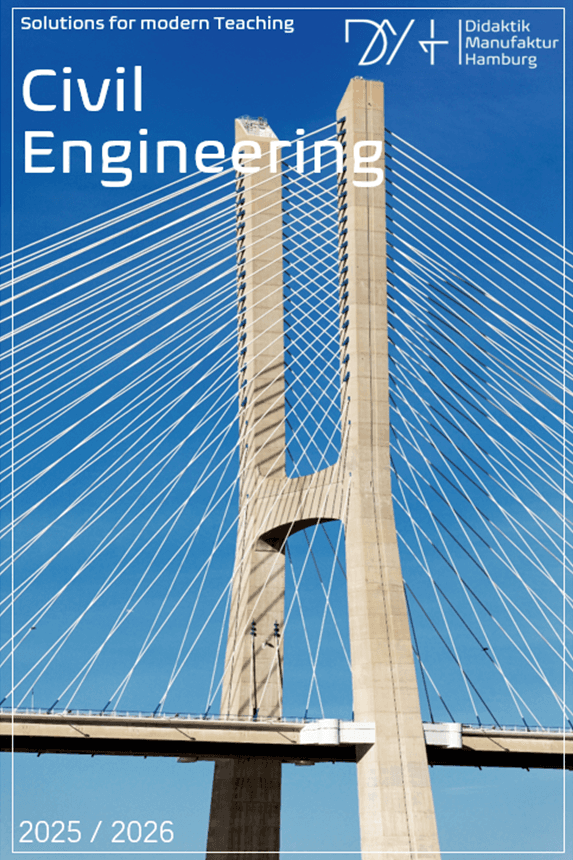
Civil Engineering

Technical solution for Civil Engineering

Back to previous page

Didactic Manufactur Hamburg provides comprehensive solutions for courses in the field of Civil Engineering for Universities, specialised Institutes and professional training facilities. 


These solutions are structured according to the different specialisations listed below and offer a well-balanced combination of didactic systems and professional-grade equipment designed for education, training as well as for some project-research fields. 


As the range of equipment associated with these specialisations is extensive and depends on the specific objectives and structure of each course, DMH prepares and provides quotations following an individual consultation to ensure the most suitable solution for your educational requirements. 


Following our philosophy, all didactic equipment will be delivered with its predefined course programme to ensure 100% utilisation of the equipment. 

Simulators and Training Systems 


  • Structural loading simulator  


  • Construction site planning simulator  


  • BIM walkthrough simulator  


  • Traffic flow simulator  


  • Hydraulic flood simulation  


  • Construction machinery simulator  


  • Disturbance / emergency scenario training  


Digital Learning Environment 


  • Computer pool / engineering workstations with GPU (minimum 30 seats for 3D/BIM/FEM) 


  • Dual-screen setups for CAD / BIM workstations 


  • Campus licences for core software  


  • Cloud / network infrastructure for simulation workloads and collaborative BIM 


  • E-learning platform with self-assessment tools  


Basic and Demonstration Sets 


  • Demonstrations on structural mechanics (force equilibrium, bending, buckling, vibration) 


  • Construction materials sample cabinet (concrete, steel, timber, masonry, glass, plastics, bitumen – systematically classified) 


  • Wall / floor / roof build-up cross-section models (thermal, acoustic, fire protection layers) 


  • Hydraulic flow models (open channel, pipe flow, groundwater flow with colour tracers) 


  • Geotechnical demonstration sets (soil types, compaction, bearing capacity, earth pressure) 


  • Pavement layer build-up models and road cross-section demonstrators 


  • Construction equipment models (sectioned pump, crane mechanics, formwork systems) 


  • Corrosion and deterioration demonstration kits (reinforcement corrosion, carbonation, ASR) 


Safety / HSE Training 


  • PPE demonstration case (helmet, safety harness, fall arrest, goggles, hearing protection, safety boots, high-vis vest) 


  • Construction site first aid training set 


  • Fire protection training set  


  • Scaffolding safety and fall protection demonstration models 


  • Safety videos + case studies  


  • Confined space entry training set  

DMH COVERS THE FOLLOWING AREAS: 


Structural Engineering: 


  • Reinforced Concrete and Prestressed Concrete Construction 


  • Steel and Composite Construction 


  • Timber Construction 


  • Bridge Engineering 


  • FEM / Numerical Methods 


Geotechnical Engineering / Foundation Engineering / Tunnelling 


  • Soil Mechanics and Foundation Engineering 


  • Tunnelling 


  • Special Foundation Engineering (Deep Foundations) 


Water Engineering / Water Resources Management 


  • Hydraulic Engineering 


  • Urban Water Management (Drinking Water / Wastewater) 


  • Hydrology and Flood Protection 


  • Traffic Engineering and Transport Planning 


  • Railway Engineering 


Construction Management and Operations 


  • Construction Scheduling and Project Management 


  • Cost Estimation and Tendering (AVA)  


  • BIM Management 


  • Construction Law and Contract Management 


  • Health and Safety on Construction Sites 


Building Physics and Construction Materials 


  • Building Physics (Thermal, Moisture, Acoustics, Fire Protection) 


  • Construction Materials Testing 


Surveying / Geoinformatics 


Building Informatics / Computational Engineering 


Sustainability and Climate Adaptation 


Smart Infrastructure / Structural Health Monitoring 


The recommended basic didactic equipment for your Civil Engineering faculty includes   


Visualisation and Teaching:  


  • Interactive display / Smartboard  


  • Document camera (for samples, cross-sections, drawings, test specimens) 


  • Projector + short-throw projection  


  • Large teaching panels and posters  


  • 3D physical models  


  • 3D printing station (for structural models, terrain models, connection details, BIM output) 

DMH COVERS THE FOLLOWING AREAS: 


Structural Engineering: 


  • Reinforced Concrete and Prestressed Concrete Construction 


  • Steel and Composite Construction 


  • Timber Construction 


  • Bridge Engineering 


  • FEM / Numerical Methods 


Geotechnical Engineering / Foundation Engineering / Tunnelling 


  • Soil Mechanics and Foundation Engineering 


  • Tunnelling 


  • Special Foundation Engineering (Deep Foundations) 


Water Engineering / Water Resources Management 


  • Hydraulic Engineering 


  • Urban Water Management (Drinking Water / Wastewater) 


  • Hydrology and Flood Protection 


  • Traffic Engineering and Transport Planning 


  • Railway Engineering 


Construction Management and Operations 


  • Construction Scheduling and Project Management 


  • Cost Estimation and Tendering (AVA)  


  • BIM Management 


  • Construction Law and Contract Management 


  • Health and Safety on Construction Sites 


Building Physics and Construction Materials 


  • Building Physics (Thermal, Moisture, Acoustics, Fire Protection) 


  • Construction Materials Testing 


Surveying / Geoinformatics 


Building Informatics / Computational Engineering 


Sustainability and Climate Adaptation 


Smart Infrastructure / Structural Health Monitoring 


The recommended basic didactic equipment for your Civil Engineering faculty includes   


Visualisation and Teaching:  


  • Interactive display / Smartboard  


  • Document camera (for samples, cross-sections, drawings, test specimens) 


  • Projector + short-throw projection  


  • Large teaching panels and posters  


  • 3D physical models  


  • 3D printing station (for structural models, terrain models, connection details, BIM output) 


Simulators and Training Systems 


  • Structural loading simulator  


  • Construction site planning simulator  


  • BIM walkthrough simulator  


  • Traffic flow simulator  


  • Hydraulic flood simulation  


  • Construction machinery simulator  


  • Disturbance / emergency scenario training  


Digital Learning Environment 


  • Computer pool / engineering workstations with GPU (minimum 30 seats for 3D/BIM/FEM) 


  • Dual-screen setups for CAD / BIM workstations 


  • Campus licences for core software  


  • Cloud / network infrastructure for simulation workloads and collaborative BIM 


  • E-learning platform with self-assessment tools  


Basic and Demonstration Sets 


  • Demonstrations on structural mechanics (force equilibrium, bending, buckling, vibration) 


  • Construction materials sample cabinet (concrete, steel, timber, masonry, glass, plastics, bitumen – systematically classified) 


  • Wall / floor / roof build-up cross-section models (thermal, acoustic, fire protection layers) 


  • Hydraulic flow models (open channel, pipe flow, groundwater flow with colour tracers) 


  • Geotechnical demonstration sets (soil types, compaction, bearing capacity, earth pressure) 


  • Pavement layer build-up models and road cross-section demonstrators 


  • Construction equipment models (sectioned pump, crane mechanics, formwork systems) 


  • Corrosion and deterioration demonstration kits (reinforcement corrosion, carbonation, ASR) 


Safety / HSE Training 


  • PPE demonstration case (helmet, safety harness, fall arrest, goggles, hearing protection, safety boots, high-vis vest) 


  • Construction site first aid training set 


  • Fire protection training set  


  • Scaffolding safety and fall protection demonstration models 


  • Safety videos + case studies  


  • Confined space entry training set  

THE FOLLOWING BASIC FRAMEWORK CONDITIONS APPLY BEFORE ANY OFFER:  

Questions: 


•    What do I want to implement? 


•    Do I have a clear vision of the structure of the individual disciplines? 


•    How deeply do I want to delve into the subject matter? 


•    What should the theory / practice ratio be? 


•    What infrastructure do I have (technical / spatial)? 


•    How well qualified are my staff? 


•    What is my budget? 


•    Which construction types are regionally relevant (residential, commercial, infrastructure, industrial)? 


•    Which structural systems should be the focus (reinforced concrete, steel, timber, masonry, composite)? 


•    Should BIM be integrated as a cross-cutting competence from year one? 


•    Which national standards and codes apply (Eurocodes, national annexes, local building codes)? 


•    Are laboratory facilities for materials testing and hydraulics already available or planned? 


•    Should sustainability certification (DGNB, BNB, LEED, BREEAM) be part of the curriculum? 


•    Is a multi-day surveying field practical planned? 

Contact us for assistance with your project.

Take advantage of our extensive experience and expertise.

Contact us for assistance with your project.

Take advantage of our extensive experience and expertise.

We will be happy to send you a personalized quote accompanied by

one or more useful extension options and modules.

We will be happy to send you a personalized quote accompanied by

one or more useful extension options and modules.

Your Didaktik Manufaktur Hamburg Team !

Your Didaktik Manufaktur Hamburg Team !

Back to previous page

..

..