Analytical Equipment
Analytical Equipment

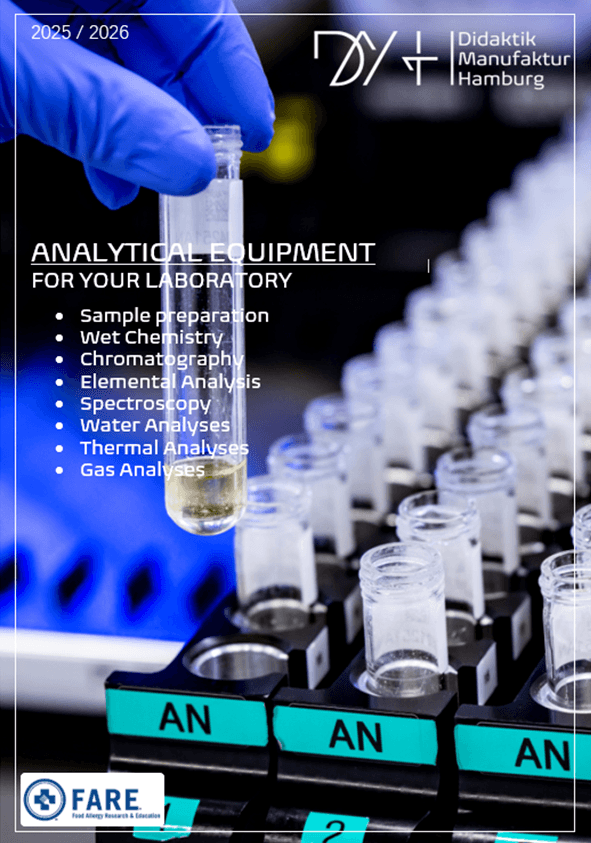
Didactic Manufactur Hamburg provides comprehensive solutions for the field of Ánalytical equipent.
These solutions are structured according to the different categories and offer a professional-grade equipment designed for education, basic and advanced analyses, as well as well as research applications.
As the range of equipment associated with these specializations is extensive and depends on the specific objectives and structure of each target, DMH prepares and provides individualized quotations following a personal consultation to ensure the most suitable solution for your analytical requirements.
Sample Preparation
Analytical balance, needed for precise weighing for reagents, standards, samples, Readability 0.1 mg; capacity 200–300 g; internal calibration
Precision balance, for routine weighing, Readability 1 mg; capacity 2–5 kg
pH meter, nedded for water, food, soil extracts. Accuracy ±0.01 pH; automatic temperature compensation
Centrifuge, required for phase separation, biological or chemical samples. Speed up to 15,000 rpm; refrigerated option
Ultrasonic bath, needed for sample extraction, cleaning glassware. Frequency ~40 kHz; volume 3–10 L
Microwave digestion system, fample digestion for ICP/AAS. Temperature up to 200–250°C; pressure up to 40 bar
Rotary evaporator, for solvent removal, concentration. Vacuum control; bath temp 20–180°C
Solid phase extraction manifold, fample cleanup for chromatography. 12–24 port vacuum manifold
Wet Chemistry
Automatic titrator, Acid/base, redox, precipitation titration. pH/ISE electrodes; auto burette 10–20 mL
Karl Fischer titrator Water content determination Coulometric or volumetric method
UV-Vis spectrophotometer, quantitative analysis of dissolved compounds. Wavelength range 190–1100 nm; double beam
FTIR spectrometer, Molecular identification Range 4000–400 cm⁻¹; ATR accessory
Chromatography
HPLC system, for pharmaceuticals, food additives, toxins. Pressure up to 400 bar; UV/Diode array detector
UHPLC system, High-resolution fast chromatography. Pressure up to 1000–1500 bar
GC-FID, for petrochemicals, solvents, hydrocarbons. Temperature up to 450°C; FID detector
GC-MS, for Volatile organics, toxins, environmental pollutants. Mass range 1–1000 m/z; EI ionization
Ion chromatography, anions/cations in water or soil. Suppressed conductivity detection
LC-MS/MS, for trace contaminants, pesticides, pharma impurities. Triple quadrupole MS; high sensitivity
Elemental Analysis
AAS, for Metal analysis in water, food, soil. Flame or graphite furnace options
ICP-OES, Multi-element analysis. Detection limits ppb; plasma ~8000 K
ICP-MS, Ultra-trace metal analysis. Detection limits ppt; mass range 7–250 amu
XRF spectrometer, Solid material elemental analysis. Energy dispersive detector
Spectroscopy
Fluorescence spectrophotometer, Trace organics, biomolecules. Excitation 200–900 nm
Raman spectrometer, Material identification, Laser 532/785 nm
NIR spectrometer, for food, pharma rapid screening Range 800–2500 nm
Thermal Analysis
DSC, Thermal transitions in materials. Temp range -150 to 600°C
TGA, Thermal stability and composition. Temp up to 1000°C
Water Analysis
TOC analyzer, for total organic carbon in water. Detection 0–30,000 ppm
BOD measurement system, Biological oxygen demand. 5-day BOD method
COD reactor, for chemical oxygen demand. Thermoreactor 150°C digestion
Gas Analysis
Portable gas analyzer, Industrial or environmental gases. Sensors for O2, CO, CO2, CH4
Headspace sampler, volatile compounds in liquids. Heated vial system 40–200°C
Infrastructure
Chemical fume hood, Safe handling of chemicals. Airflow ~0.5 m/s
Safety shower & eye wash, Emergency chemical exposure. ANSI/EN compliant
Flammable storage cabinet, Storage of solvents. Fire resistant 90 min
Gas distribution system, Carrier gases for GC/ICP. High purity gas regulators
LIMS software, Laboratory data management. Sample tracking & reporting
Before palning DMH highly recommand to clarify the following key-point :
what sample types you will analyze ?
expected number of students ?
expected number of samples per day ?
whether the lab is for teaching, research, or commercial service ?
target methods and standards ?
required detection limits ?
available utilities: power, water, gas, ventilation ?
maintenance capacity and local service support ?
budget for consumables, not only instruments ?
As this kind of equipment belongs to the most complicated to train, you should also clarify the available experience within your staff.