

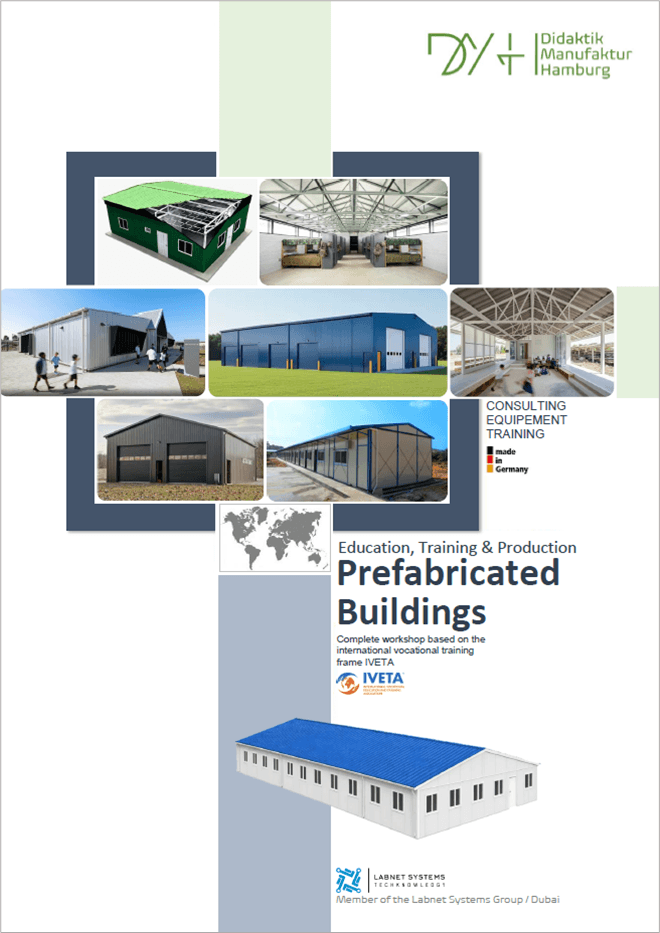
Prefabricated Buildings

Modular Construction & Industrial Building Technology
This department creates infrastructure – for schools, clinics, accommodations, and other building uses – while simultaneously providing the foundation for hands-on advanced training across a wide range of occupational groups in the field of Technical & Vocational Education.
Qualified professionals from the main departments of Welding, Metal Fabrication, Electrical, Plumbing, Carpentry, Painting/Coating, and CAD Design are strategically deployed on real modular construction sites.
They learn to work across disciplines and on a project basis.
Local training with social commitment fosters a sense of responsibility among apprentices, while simultaneously enabling cost-effective on-site assembly, as apprentices are actively involved in the construction process and will eventually be able to plan, fabricate, and independently erect modular buildings themselves.
This means that with each cohort and across the various trades, a new building can be constructed as a final project – creating significant added value for the community and local infrastructure.
Occupational Groups from the Main Departments
Qualified Professionals – Advanced Knowledge in Prefabricated Buildings
Welding – Metal joining techniques for steel structures and frame construction
Metal Fabrication – Design and assembly of steel structures, frames and industrial hardware
Electrical – Wiring, control systems and power distribution in modular buildings
Plumbing – Water, wastewater and heating installations (installation & commissioning)
Carpentry – Interior finishing, doors, windows, partitions and surface treatment
Painter/Coater – Surface preparation, coatings and quality control
CAD Design – 3D modelling, production drawings and BIM coordination
Learning Fields of the Advanced Training Programme
Competency Development in 8 Strategic Learning Fields – from Materials to Buildings
Building Systems – Ventilation, water, electrical installation, controls and integration
Interior Finishing & Surface Finishes – Drywall, cladding, flooring, paints and wallpapers
Quality Control & Testing – Acceptance procedures, safety inspections and documentation
Logistics & Supply Chain – Procurement, warehouse management, scheduling and transport management
Operations Management – Project planning, schedule, budget, safety and resource management
Assembly & Commissioning – On-site: setup, connections, testing, training and handover
Digitalisation & BIM – CAD, 3D modelling, facility management and digital documentation
Building Types & Application Fields
Flexible Solutions for Diverse Requirements
Schools – Classrooms, laboratories, libraries and office buildings – fast, flexible and expandable
Production & Workshop Facilities – Warehouses, manufacturing facilities, tailoring, kitchens, bakeries, oilseed production – robust and functional
Office & Administrative Buildings – Open-plan offices, meeting rooms and break-out spaces – modern and energy-efficient
Clinics & Medical Facilities – Isolation units, treatment rooms, patient rooms and sanitary facilities – ready to deploy and certified
Residential Accommodations – Housing modules, student dormitories – fast and affordable solutions
Military Barracks – Fast, flexible and high-quality space solutions for accommodations and functional buildings
Emergency Shelters – Rapid deployment after earthquakes/disasters, refugee camps
Benefits for Apprentices
Hands-On Advanced Training
Apprentices work on real buildings being constructed on-site – not just in classrooms or laboratories. Each cohort constructs a building as their final project.
International Certificate: By involving apprentices directly in the assembly process alongside the European manufacturing partner on-site, trainees receive a recognised international training certificate upon successful completion.
Job Market Opportunities: The specialised knowledge opens doors in the modular construction industry – one of the fastest-growing sectors.
Entrepreneurship: Graduates can work as planners, project managers or business partners in modular construction.
Social Commitment: Apprentices create real infrastructure for schools, clinics and communities – with local impact.
Global Markets: Modular construction is international: graduates can work in this sector anywhere in the world.
Didactics & Workshop Equipment: Professional infrastructure and modern learning environments.
Core Equipment
Professional equipment is the backbone of successful training.
The „Prefabricated Buildings“ department is designed so that apprentices can additionally access the fully equipped workshops of the individual main departments, or the entire setup can be carried out by our contracted partner.
In either case, the apprentices are fully involved. The didactic approach follows the principle of learning by doing: theoretical concepts are immediately applied to practical projects.
Sandwich Panel Sample Wall (removable) – Construction and insulation comparison: PU / EPS / mineral wool
Scale Model of a Modular Building (1:20) – Complete system: frame + panel + building services
Electrical Practice Control Panel & Plumbing Practice Wall – Modular installation, VDE-compliant
CAD/BIM Workstations (20 stations) – AutoCAD, Revit, Tekla
Assembly Practice Field (Outdoor) – Realistic construction site simulation
Light Steel Construction Assembly Station – Cutting, connecting and assembling C-profiles
PPE Safety Equipment (30 persons) – Mandatory for all workshop exercises
Objective of the Advanced Training Programme
The programme upskills already qualified professionals so that they can plan modular buildings, understand industrial prefabrication, coordinate construction projects and apply modern assembly technologies – a bridge between construction, manufacturing and project management.
At the same time, real infrastructure is created on-site: schools, clinics, accommodations and production facilities built by the apprentices themselves.
Get in Touch – Framework Conditions
To clarify the framework conditions for your project, we would ask you to clarify the following questions:
What purposes will the buildings serve (school, clinic, accommodation, barracks, kitchen, office)?
Which trades should be covered (steel construction, electrical, plumbing, carpentry, painting, all)?
Own training workshop with assembly practice field or external facilities?
Should sub-departments (tailoring, bakery, butchery, cheese dairy, roastery, fruit juice) be accommodated in modular buildings?
How many apprentices per year (sizing of workshops & buildings)?
Dual system (company + school) or full-time school?
Size / number of modules (30–660+ m²)? Storeys (1–3)?
Furnishing (basic / fully furnished, air conditioning, sanitary facilities)?
Transport and assembly location (region, climate, infrastructure)?
Conclusion
Modular construction is a rapidly growing sector of the construction industry.
An advanced training programme in modular construction and industrial building technology upskills already qualified professionals – in planning, production and assembly of modern building systems.
At the same time, the Sub-Department concept creates infrastructure on-site: schools, clinics, accommodations and production facilities erected by the apprentices themselves.
The result is a dual benefit: hands-on training with an international certificate, personal responsibility and a real reference project for every participant – and for funders, regions and industry partners, a scalable model that combines education and infrastructure in a single investment.
Comprehensive trainer instruction is essential for the optimal setup and operation of the buildings.
In addition to on-site training following construction and fit-out of the prefabricated buildings and infrastructure, installation and commissioning, a 5 to 7-day training programme takes place at our manufacturing partner’s facilities in Europe prior to shipment of the modular buildings.
This training covers all required process details.
Modular Construction & Industrial Building Technology
This department creates infrastructure – for schools, clinics, accommodations, and other building uses – while simultaneously providing the foundation for hands-on advanced training across a wide range of occupational groups in the field of Technical & Vocational Education.
Qualified professionals from the main departments of Welding, Metal Fabrication, Electrical, Plumbing, Carpentry, Painting/Coating, and CAD Design are strategically deployed on real modular construction sites.
They learn to work across disciplines and on a project basis.
Local training with social commitment fosters a sense of responsibility among apprentices, while simultaneously enabling cost-effective on-site assembly, as apprentices are actively involved in the construction process and will eventually be able to plan, fabricate, and independently erect modular buildings themselves.
This means that with each cohort and across the various trades, a new building can be constructed as a final project – creating significant added value for the community and local infrastructure.
Occupational Groups from the Main Departments
Qualified Professionals – Advanced Knowledge in Prefabricated Buildings
Welding – Metal joining techniques for steel structures and frame construction
Metal Fabrication – Design and assembly of steel structures, frames and industrial hardware
Electrical – Wiring, control systems and power distribution in modular buildings
Plumbing – Water, wastewater and heating installations (installation & commissioning)
Carpentry – Interior finishing, doors, windows, partitions and surface treatment
Painter/Coater – Surface preparation, coatings and quality control
CAD Design – 3D modelling, production drawings and BIM coordination
Learning Fields of the Advanced Training Programme
Competency Development in 8 Strategic Learning Fields – from Materials to Buildings
Building Systems – Ventilation, water, electrical installation, controls and integration
Interior Finishing & Surface Finishes – Drywall, cladding, flooring, paints and wallpapers
Quality Control & Testing – Acceptance procedures, safety inspections and documentation
Logistics & Supply Chain – Procurement, warehouse management, scheduling and transport management
Operations Management – Project planning, schedule, budget, safety and resource management
Assembly & Commissioning – On-site: setup, connections, testing, training and handover
Digitalisation & BIM – CAD, 3D modelling, facility management and digital documentation
Building Types & Application Fields
Flexible Solutions for Diverse Requirements
Schools – Classrooms, laboratories, libraries and office buildings – fast, flexible and expandable
Production & Workshop Facilities – Warehouses, manufacturing facilities, tailoring, kitchens, bakeries, oilseed production – robust and functional
Office & Administrative Buildings – Open-plan offices, meeting rooms and break-out spaces – modern and energy-efficient
Clinics & Medical Facilities – Isolation units, treatment rooms, patient rooms and sanitary facilities – ready to deploy and certified
Residential Accommodations – Housing modules, student dormitories – fast and affordable solutions
Military Barracks – Fast, flexible and high-quality space solutions for accommodations and functional buildings
Emergency Shelters – Rapid deployment after earthquakes/disasters, refugee camps
Benefits for Apprentices
Hands-On Advanced Training
Apprentices work on real buildings being constructed on-site – not just in classrooms or laboratories. Each cohort constructs a building as their final project.
International Certificate: By involving apprentices directly in the assembly process alongside the European manufacturing partner on-site, trainees receive a recognised international training certificate upon successful completion.
Job Market Opportunities: The specialised knowledge opens doors in the modular construction industry – one of the fastest-growing sectors.
Entrepreneurship: Graduates can work as planners, project managers or business partners in modular construction.
Social Commitment: Apprentices create real infrastructure for schools, clinics and communities – with local impact.
Global Markets: Modular construction is international: graduates can work in this sector anywhere in the world.
Didactics & Workshop Equipment: Professional infrastructure and modern learning environments.
Core Equipment
Professional equipment is the backbone of successful training.
The „Prefabricated Buildings“ department is designed so that apprentices can additionally access the fully equipped workshops of the individual main departments, or the entire setup can be carried out by our contracted partner.
In either case, the apprentices are fully involved. The didactic approach follows the principle of learning by doing: theoretical concepts are immediately applied to practical projects.
Sandwich Panel Sample Wall (removable) – Construction and insulation comparison: PU / EPS / mineral wool
Scale Model of a Modular Building (1:20) – Complete system: frame + panel + building services
Electrical Practice Control Panel & Plumbing Practice Wall – Modular installation, VDE-compliant
CAD/BIM Workstations (20 stations) – AutoCAD, Revit, Tekla
Assembly Practice Field (Outdoor) – Realistic construction site simulation
Light Steel Construction Assembly Station – Cutting, connecting and assembling C-profiles
PPE Safety Equipment (30 persons) – Mandatory for all workshop exercises
Objective of the Advanced Training Programme
The programme upskills already qualified professionals so that they can plan modular buildings, understand industrial prefabrication, coordinate construction projects and apply modern assembly technologies – a bridge between construction, manufacturing and project management.
At the same time, real infrastructure is created on-site: schools, clinics, accommodations and production facilities built by the apprentices themselves.
Get in Touch – Framework Conditions
To clarify the framework conditions for your project, we would ask you to clarify the following questions:
What purposes will the buildings serve (school, clinic, accommodation, barracks, kitchen, office)?
Which trades should be covered (steel construction, electrical, plumbing, carpentry, painting, all)?
Own training workshop with assembly practice field or external facilities?
Should sub-departments (tailoring, bakery, butchery, cheese dairy, roastery, fruit juice) be accommodated in modular buildings?
How many apprentices per year (sizing of workshops & buildings)?
Dual system (company + school) or full-time school?
Size / number of modules (30–660+ m²)? Storeys (1–3)?
Furnishing (basic / fully furnished, air conditioning, sanitary facilities)?
Transport and assembly location (region, climate, infrastructure)?
Conclusion
Modular construction is a rapidly growing sector of the construction industry.
An advanced training programme in modular construction and industrial building technology upskills already qualified professionals – in planning, production and assembly of modern building systems.
At the same time, the Sub-Department concept creates infrastructure on-site: schools, clinics, accommodations and production facilities erected by the apprentices themselves.
The result is a dual benefit: hands-on training with an international certificate, personal responsibility and a real reference project for every participant – and for funders, regions and industry partners, a scalable model that combines education and infrastructure in a single investment.
Comprehensive trainer instruction is essential for the optimal setup and operation of the buildings.
In addition to on-site training following construction and fit-out of the prefabricated buildings and infrastructure, installation and commissioning, a 5 to 7-day training programme takes place at our manufacturing partner’s facilities in Europe prior to shipment of the modular buildings.
This training covers all required process details.
Contact us for assistance with your project.
Take advantage of our extensive experience and expertise.
We will be happy to send you a personalized quote accompanied by
one or more useful extension options and modules.
Your Didaktik Manufaktur Hamburg Team !

Back to previous page


Contact us for assistance with your project.
Take advantage of our extensive experience and expertise.
We will be happy to send you a personalized quote accompanied by
one or more useful extension options and modules.
Your Didaktik Manufaktur Hamburg Team !
Back to previous page
Contact us for assistance with your project.
Take advantage of our extensive experience and expertise.
We will be happy to send you a personalized quote accompanied by
one or more useful extension options and modules.
Your Didaktik Manufaktur Hamburg Team !