
Oilseed Processing
Oilseed Processing
Workshop for Cassava Flour with complete production line
Back to previous page

Oilseed processing is a complex process that requires both in-depth knowledge and appropriate equipment.
For trainees, small entrepreneurs, and vocational schools in Sub-Saharan Africa, access to high-quality technology and practical guidance is crucial to produce high-quality edible oils, make meaningful use of by-products, and achieve economic success.
This comprehensive offer provides all necessary machines, tools, and didactic content required for vocational schools, training programs, and small-scale businesses in oilseed processing. It is a turnkey complete solution that creates a safe, efficient, and economically viable learning and production environment.
Workshop Content
1. The workshop is designed in its standard configuration for 12 to 18 participants.
2. The facility is fully equipped and complies with international hygiene standards as well as common requirements for food processing.
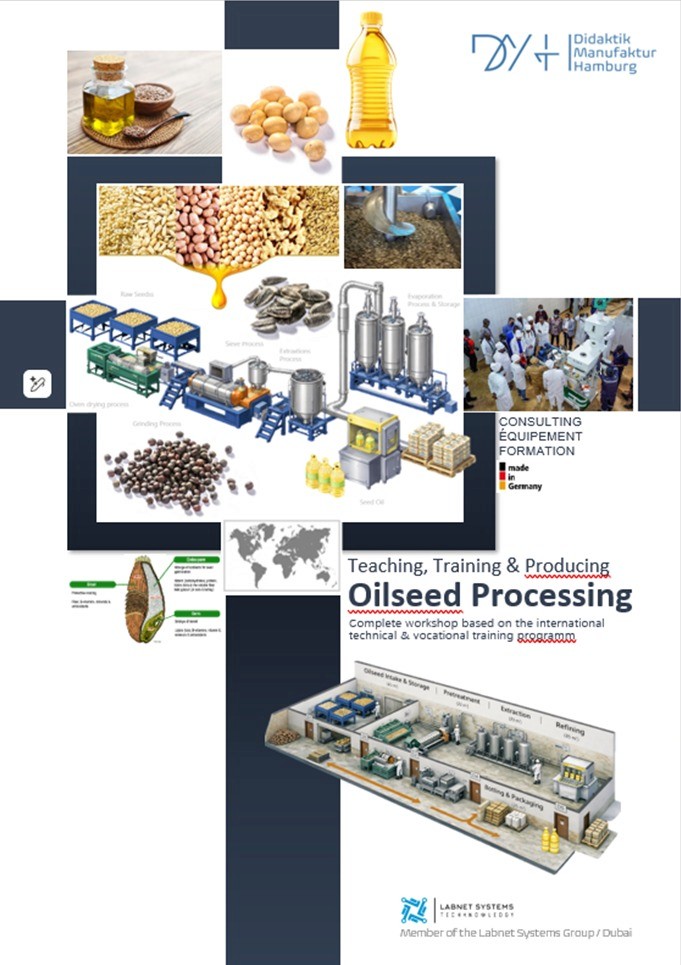
3. The professional equipment covers the entire process – from raw material intake to filling:
Pre-cleaning – Drying – Dehulling – Pre-treatment – Mechanical pressing – Filtration – Optional refining – Filling & Labeling.
4. The standard plant has a capacity of approximately 2,000–2,500 tons of oilseeds per year (based on 250 working days and 8–10 t/day).
Variants ranging are available upon request.
5. The plant is designed for processing the most important regional oilseeds:
Groundnut (Peanut) · Sesame · Sunflower · Soybean
(Switching between seed types is possible with minimal conversion effort).
Processing instructions, pressing parameters, and recipes are included in the delivery.
6. To ensure optimal operation and effective knowledge transfer, the package includes:
– On-site installation & commissioning training (5–7 days)
– 10–12-day intensive Train-the-Trainer program at the manufacturer’s facility (India / China) prior to shipment
Topics: Process technology, maintenance, quality control, HACCP basics, troubleshooting
7. A comprehensive set of accessories (measuring instruments, basic laboratory equipment, safety gear, tools, starter spare parts package) completes the turnkey solution.
Didactic Content
The training program has been specifically developed for vocational schools, TVET institutes, and small entrepreneurs.
The goal is to enable participants to master the entire value chain – from raw material selection to sales – in terms of quality, hygiene, and economics.
The program combines theory, hands-on practice, case studies, and real production projects.
Upon completion, participants will be able to:
1. Understand the chemical, physical, and agronomic fundamentals of oil extraction
2. Select, store, and pre-treat the four main oilseeds (groundnut, sesame, sunflower, soybean) according to quality standards
3. Independently and safely carry out the complete mechanical pressing process
4. Measure and evaluate key quality parameters (acid value, peroxide value, moisture, sensory evaluation)
5. Optimize pressing parameters and produce different oil qualities (cold-pressed, refined, premium)
6. Manage, calculate costs for, and market a small oil mill from a business perspective
Program Structure by Modules
Module 1 – Introduction & History
- History of oil extraction in different cultures
- Global significance of edible oils today
- Economic importance for Sub-Saharan Africa
- Overview of traditional and modern production methods
Module 2 – Raw Materials
- Botany and agronomy of the most important oilseeds
- Groundnut: Oil content 45–50 %, quality characteristics
- Sesame: Oil content 50–55 %, specifics of cold pressing
- Sunflower: Oil content 40–45 %, dehulling requirements
- Soybean: Oil content 18–20 %, anti-nutritional factors & inactivation
- Storage, moisture management, and quality preservation
Module 3 – Scientific Fundamentals
- Chemistry of fats and oils
- Typical fatty acid composition of the four oilseeds
- Physical properties (viscosity, melting point, smoke point)
- Oxidation, rancidity, and stabilization
- Nutritional profile and health aspects of edible oils
Module 4 – Processing Workflow
- Pre-cleaning: Sieving, magnetic separation, stone removal
- Drying & moisture management
- Dehulling: Techniques for groundnut, sunflower, soybean
- Pre-treatment: Crushing, flaking, conditioning
- Pressing: Cold vs. warm/hot pressing, screw presses
- Filtration, sedimentation, and clarification
- Optional refining (degumming, neutralization, bleaching, deodorization)
Module 5 – Plants & Machinery
- Functioning of the main equipment
- Screw presses: Design, screw types, operating parameters
- Dehulling machines & dehullers (different types)
- Conditioners, cookers, extruders
- Filtration and separation systems (plate filters, vacuum filters)
- Maintenance, lubrication, common faults & troubleshooting
- Machine safety
Module 6 – Quality Control
- Most important analytical parameters (acid value, peroxide value, moisture, unsaponifiable matter)
- Simple laboratory equipment and measurement methods
- Sensory evaluation of crude and edible oils
- Regional and international quality standards
- Traceability, batch documentation, HACCP basics
Module 7 – Recipe Development & Product Optimization
- Development of oil blends (e.g. groundnut-sesame, sunflower-soybean)
- Production of flavored oils
- Optimization of pressing parameters for higher yield / better quality
- Utilization of press cake & by-products (animal feed, soap, fuel)
- Market trends: cold-pressed premium oils, organic oils, functional oils
Module 8 – Regulations, Hygiene & Safety
- Food safety & HACCP in oil production
- National regulations (e.g. Nigeria, Ghana, Kenya, Tanzania)
- International standards (Codex Alimentarius, EU import requirements)
- GMP – Good Manufacturing Practice
- Personal & operational hygiene
- Occupational safety & fire protection
- Environmental aspects, wastewater & waste management
Module 9 – Business Management & Marketing
- Cost accounting & calculation for a small oil mill
- Business economics & break-even analysis
- Marketing & sales of edible oils (local & regional)
- Building your own brand & packaging design
- Customer loyalty & customer service
- Business planning for small and micro-enterprises
Module 10 – Final Project
Independent project: Planning, production, quality control, costing, and marketing concept for an own oil or oil blend – including presentation and evaluation.
Self-Financing Opportunities
In addition to its purely educational role, the workshop offers excellent opportunities for self-financing:
- Sale of the produced edible oil (filling and labeling machine included in the scope of supply)
- Contract pressing for local farmers
- Sale of press cake as animal feed
- Additional paid training courses for other small entrepreneurs and farmers
- Production and sale of premium products (cold-pressed sesame oil, flavored oil
Additionally we offer the following extension Modules
Oilseed processing is a complex process that requires both in-depth knowledge and appropriate equipment.
For trainees, small entrepreneurs, and vocational schools in Sub-Saharan Africa, access to high-quality technology and practical guidance is crucial to produce high-quality edible oils, make meaningful use of by-products, and achieve economic success.
This comprehensive offer provides all necessary machines, tools, and didactic content required for vocational schools, training programs, and small-scale businesses in oilseed processing. It is a turnkey complete solution that creates a safe, efficient, and economically viable learning and production environment.
Workshop Content
1. The workshop is designed in its standard configuration for 12 to 18 participants.
2. The facility is fully equipped and complies with international hygiene standards as well as common requirements for food processing.
3. The professional equipment covers the entire process – from raw material intake to filling:
Pre-cleaning – Drying – Dehulling – Pre-treatment – Mechanical pressing – Filtration – Optional refining – Filling & Labeling.
4. The standard plant has a capacity of approximately 2,000–2,500 tons of oilseeds per year (based on 250 working days and 8–10 t/day).
Variants ranging are available upon request.
5. The plant is designed for processing the most important regional oilseeds:
Groundnut (Peanut) · Sesame · Sunflower · Soybean
(Switching between seed types is possible with minimal conversion effort).
Processing instructions, pressing parameters, and recipes are included in the delivery.
6. To ensure optimal operation and effective knowledge transfer, the package includes:
– On-site installation & commissioning training (5–7 days)
– 10–12-day intensive Train-the-Trainer program at the manufacturer’s facility (India / China) prior to shipment
Topics: Process technology, maintenance, quality control, HACCP basics, troubleshooting
7. A comprehensive set of accessories (measuring instruments, basic laboratory equipment, safety gear, tools, starter spare parts package) completes the turnkey solution.
Didactic Content
The training program has been specifically developed for vocational schools, TVET institutes, and small entrepreneurs.
The goal is to enable participants to master the entire value chain – from raw material selection to sales – in terms of quality, hygiene, and economics.
The program combines theory, hands-on practice, case studies, and real production projects.
Upon completion, participants will be able to:
1. Understand the chemical, physical, and agronomic fundamentals of oil extraction
2. Select, store, and pre-treat the four main oilseeds (groundnut, sesame, sunflower, soybean) according to quality standards
3. Independently and safely carry out the complete mechanical pressing process
4. Measure and evaluate key quality parameters (acid value, peroxide value, moisture, sensory evaluation)
5. Optimize pressing parameters and produce different oil qualities (cold-pressed, refined, premium)
6. Manage, calculate costs for, and market a small oil mill from a business perspective
Program Structure by Modules
Module 1 – Introduction & History
- History of oil extraction in different cultures
- Global significance of edible oils today
- Economic importance for Sub-Saharan Africa
- Overview of traditional and modern production methods
Module 2 – Raw Materials
- Botany and agronomy of the most important oilseeds
- Groundnut: Oil content 45–50 %, quality characteristics
- Sesame: Oil content 50–55 %, specifics of cold pressing
- Sunflower: Oil content 40–45 %, dehulling requirements
- Soybean: Oil content 18–20 %, anti-nutritional factors & inactivation
- Storage, moisture management, and quality preservation
Module 3 – Scientific Fundamentals
- Chemistry of fats and oils
- Typical fatty acid composition of the four oilseeds
- Physical properties (viscosity, melting point, smoke point)
- Oxidation, rancidity, and stabilization
- Nutritional profile and health aspects of edible oils
Module 4 – Processing Workflow
- Pre-cleaning: Sieving, magnetic separation, stone removal
- Drying & moisture management
- Dehulling: Techniques for groundnut, sunflower, soybean
- Pre-treatment: Crushing, flaking, conditioning
- Pressing: Cold vs. warm/hot pressing, screw presses
- Filtration, sedimentation, and clarification
- Optional refining (degumming, neutralization, bleaching, deodorization)
Module 5 – Plants & Machinery
- Functioning of the main equipment
- Screw presses: Design, screw types, operating parameters
- Dehulling machines & dehullers (different types)
- Conditioners, cookers, extruders
- Filtration and separation systems (plate filters, vacuum filters)
- Maintenance, lubrication, common faults & troubleshooting
- Machine safety
Module 6 – Quality Control
- Most important analytical parameters (acid value, peroxide value, moisture, unsaponifiable matter)
- Simple laboratory equipment and measurement methods
- Sensory evaluation of crude and edible oils
- Regional and international quality standards
- Traceability, batch documentation, HACCP basics
Module 7 – Recipe Development & Product Optimization
- Development of oil blends (e.g. groundnut-sesame, sunflower-soybean)
- Production of flavored oils
- Optimization of pressing parameters for higher yield / better quality
- Utilization of press cake & by-products (animal feed, soap, fuel)
- Market trends: cold-pressed premium oils, organic oils, functional oils
Module 8 – Regulations, Hygiene & Safety
- Food safety & HACCP in oil production
- National regulations (e.g. Nigeria, Ghana, Kenya, Tanzania)
- International standards (Codex Alimentarius, EU import requirements)
- GMP – Good Manufacturing Practice
- Personal & operational hygiene
- Occupational safety & fire protection
- Environmental aspects, wastewater & waste management
Module 9 – Business Management & Marketing
- Cost accounting & calculation for a small oil mill
- Business economics & break-even analysis
- Marketing & sales of edible oils (local & regional)
- Building your own brand & packaging design
- Customer loyalty & customer service
- Business planning for small and micro-enterprises
Module 10 – Final Project
Independent project: Planning, production, quality control, costing, and marketing concept for an own oil or oil blend – including presentation and evaluation.
Self-Financing Opportunities
In addition to its purely educational role, the workshop offers excellent opportunities for self-financing:
- Sale of the produced edible oil (filling and labeling machine included in the scope of supply)
- Contract pressing for local farmers
- Sale of press cake as animal feed
- Additional paid training courses for other small entrepreneurs and farmers
- Production and sale of premium products (cold-pressed sesame oil, flavored oil
Additionally we offer the following extension Modules
Contact us for assistance with your project.
Take advantage of our extensive experience and expertise.
We will be happy to send you a personalized quote accompanied by
one or more useful extension options and modules.
Your Didaktik Manufaktur Hamburg Team !

Back to previous page

Contact us for assistance with your project.
Take advantage of our extensive experience and expertise.
We will be happy to send you a personalized quote accompanied by
one or more useful extension options and modules.
Your Didaktik Manufaktur Hamburg Team !
Back to previous page
Contact us for assistance with your project.
Take advantage of our extensive experience and expertise.
We will be happy to send you a personalized quote accompanied by
one or more useful extension options and modules.
Your Didaktik Manufaktur Hamburg Team !