


Leather Making
Leather making - Leather Goods
Back to previous page

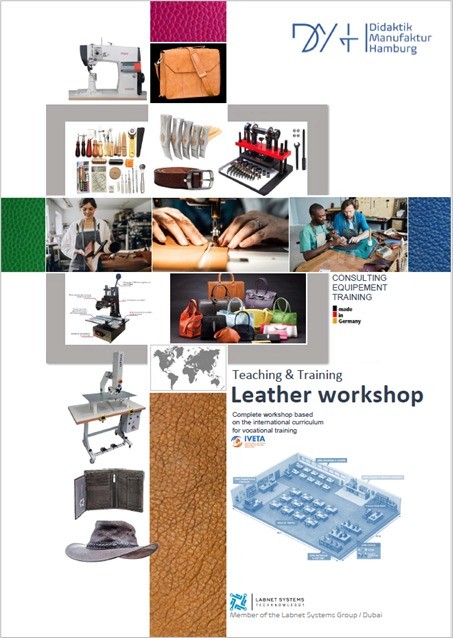
Complete leather making workshop
complete professional / industrial equipment
Leatherworkers make a variety of leather goods, such as handbags, wallets, leather gloves, belts, and of course various leather clothing items.
The goal of our complete workshop-equipment is to offer not only traditional methods but also industrial processes, and to introduce students to all modern techniques. In addition to the equipment, we provide a tailored teaching program that gradually trains apprentices to become step-by-step leather experts.
Rigorous training requires learning specific sewing, cutting, and finishing techniques for leather.
Leatherworkers also use specialized tools to work with leather, such as skiving knives, leather needles, or punches, not to mention certain machines and specific consumables.
Some leatherworkers, called pattern makers, focus on placing floral patterns and complex designs on leather items.
Leather craftsmanship requires great precision and true skill in working with leather, making each creation a unique work of art.
In this context, while taking into account the different leather sewing methods (saddle stitching, machine stitching, simple hand stitching, or decorative stitching), we offer you a complete solution including all the equipment needed for your training workshop.
Complete Leather Workshop / Maroquinerie
for 20 trainess
Conditions:
Target group: vocational school students (apprenticeship training or modular further training),
Teaching approach: 70–80% practical work, 20–30% theory
Learners objectives :
Select and prepare leather and material combinations in a professional manner.
Produce leather cuttings (including templates, tolerances, and material efficiency).
Safely operate industrial leather sewing machines (walking foot / cylinder bed).
Glue, fix, sew, and assemble according to a process plan.
Finish edges professionally (sanding, dyeing, burnishing).
Correctly set hardware (rivets, eyelets, snap fasteners, buckles).
Carry out quality controls and analyze defects.
Organize workstations safely (occupational safety, machine maintenance, orderliness).
Short modular learning structure
Learning objectives A: Apply safety rules in the leather workshop; basic knowledge of types of leather, common defects, processing characteristics, and tool handling / correct cutting technique.
Learning objectives B: Create patterns/templates and cut reproducibly; prepare edges for gluing/turn-overs; plan material utilization (nesting).
Learning objectives C: Set up machines (needle, thread tension, stitch length); sew straight seams, corners, curves, and thick intersections safely; troubleshoot machine malfunctions (thread breakage, skipped stitches)
Learning objectives D: Sand, dye, and seal cut edges; set hardware (rivets, eyelets, snap fasteners); final assembly according to quality standards.
Leatherworkers make a variety of leather goods, such as handbags, wallets, leather gloves, belts, and of course various leather clothing items.
The goal of our complete workshop-equipment is to offer not only traditional methods but also industrial processes, and to introduce students to all modern techniques. In addition to the equipment, we provide a tailored teaching program that gradually trains apprentices to become step-by-step leather experts.
Rigorous training requires learning specific sewing, cutting, and finishing techniques for leather.
Leatherworkers also use specialized tools to work with leather, such as skiving knives, leather needles, or punches, not to mention certain machines and specific consumables.
Some leatherworkers, called pattern makers, focus on placing floral patterns and complex designs on leather items.
Leather craftsmanship requires great precision and true skill in working with leather, making each creation a unique work of art.
In this context, while taking into account the different leather sewing methods (saddle stitching, machine stitching, simple hand stitching, or decorative stitching), we offer you a complete solution including all the equipment needed for your training workshop.
Complete Leather Workshop / Maroquinerie
for 20 apprentices
Conditions:
Target group: vocational school students (apprenticeship training or modular further training),
Teaching approach: 70–80% practical work, 20–30% theory
Learners objectives :
Select and prepare leather and material combinations in a professional manner.
Produce leather cuttings (including templates, tolerances, and material efficiency).
Safely operate industrial leather sewing machines (walking foot / cylinder bed).
Glue, fix, sew, and assemble according to a process plan.
Finish edges professionally (sanding, dyeing, burnishing).
Correctly set hardware (rivets, eyelets, snap fasteners, buckles).
Carry out quality controls and analyze defects.
Organize workstations safely (occupational safety, machine maintenance, orderliness).
Short modular learning structure
Learning objectives A: Apply safety rules in the leather workshop; basic knowledge of types of leather, common defects, processing characteristics, and tool handling / correct cutting technique.
Learning objectives B: Create patterns/templates and cut reproducibly; prepare edges for gluing/turn-overs; plan material utilization (nesting).
Learning objectives C: Set up machines (needle, thread tension, stitch length); sew straight seams, corners, curves, and thick intersections safely; troubleshoot machine malfunctions (thread breakage, skipped stitches)
Learning objectives D: Sand, dye, and seal cut edges; set hardware (rivets, eyelets, snap fasteners); final assembly according to quality standards.
Contact us for assistance with your project.
Take advantage of our extensive experience and expertise.
We will be happy to send you a personalized quote accompanied by
one or more useful extension options and modules.
Your Didaktik Manufaktur Hamburg Team !

Back to previous page

Contact us for assistance with your project.
Take advantage of our extensive experience and expertise.
We will be happy to send you a personalized quote accompanied by
one or more useful extension options and modules.
Your Didaktik Manufaktur Hamburg Team !
Back to previous page
Contact us for assistance with your project.
Take advantage of our extensive experience and expertise.
We will be happy to send you a personalized quote accompanied by
one or more useful extension options and modules.
Your Didaktik Manufaktur Hamburg Team !
Back to previous page