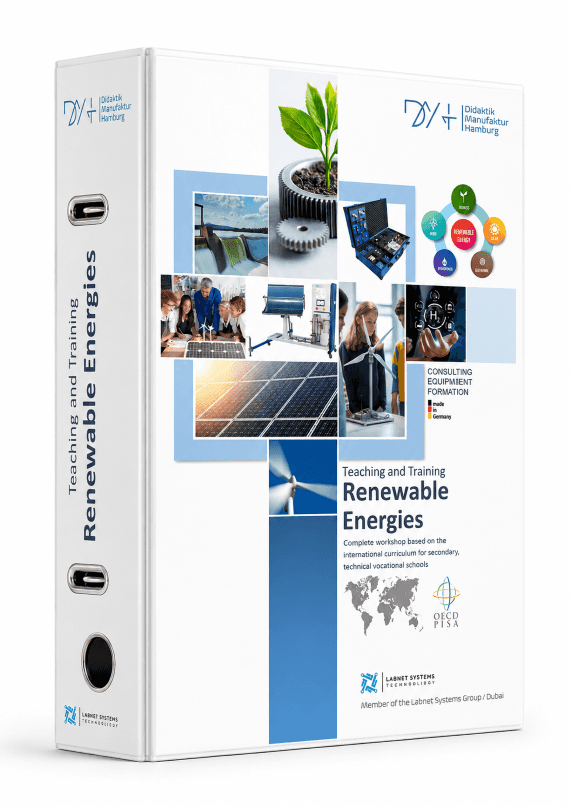
Renewable Energies
Renewable Energies

Back to previous page
To support this approach, DMH offers complete, topic-specific kit solutions.
These kits, designed for use in secondary, technical, or vocational schools,
enable learners to connect theory with experimentation and applied learning.
• The coordinated content is supplied in durable and robust boxes.
• All experiments include comprehensive manuals and experiment guides.
• Each BOX, is designed for 4 to 5 students.
Our portfolio of fully equiped kits covers the following main areas:
Box 1 Biofuel-SET
Biodiesel production, Alcohol fermentation, Distillation and production of Bioethanol, Ethanol fuels
Box 2 BioEnergy-SET
Germination of plant seeds, Plant growth in a hydroculture, Consumption of water and nutrients,
Aerobic degradation of biomass in a compost, Anaerobic degradation of biomass to form hydrogen,
Anaerobic degradation of biomass to form methane
Box 3 Emobility-SET
The BOX set allows analysis of various battery types (lead, NiMH, LiPo) and a PEM fuel cell,
including internal resistance measurement, and provides always-ready batteries with
the integrated charger for hands-on renewable energy training.
Box 4 EnergySave-SET
Students first explore topics like global energy use, climate change,
or household energy consumption.
They conduct measurements—such as room climate, water, and energy
use—to identify potential improvements.
The solution includes over 16 experiments across key areas.
Box 5 Hydrogen H2O-SET
Explore hydrogen technology with solar or mains-powered electrolysis.
The new dismantlable 1 W fuel cell stack allows experiments on the full module or individual cells.
Includes a wind machine and vehicle chassis for hands-on demonstrations.
Box 6 Hydropower-SET
The complete kit combines qualitative introductory experiments with fundamental quantitative
investigations into the physics of water turbines.
Emphasizing real-world relevance, it includes multiple turbine types, ranging from a simple water
wheel to a highly efficient modern Pelton turbine.
Box 7 BasicEnergy-SET
Designed as an introduction set for Renewable Energies with more than 20 different
experiments, and provides by qualitative and quantitative experiments an understanding
of the topics photovoltaic, wind power, hydro power, electric mobility and fuel cells.
With the enclosed Smart Control components, an innovative measuring and control system
is available and all necessary accessories like power supply, cables and measuring devices
are already included.
Box 8 Photovoltaics-SET
The experiment set covers a broad range from the physical fundamentals of photovoltaics
and the analysis of PV system components to the design of complex laboratory-scale PV systems.
It is suitable for education and training of technicians, installers, sales personnel, and engineers,
and includes more than 25 experiments.
Box 9 Smartgrid-SET
This complete set enables the construction of a laboratory-scale smart grid with renewable
energy sources.
Different generation profiles can be selected to analyze their impact on system behavior.
Various storage units and consumer loads allow the creation of multiple smart grid scenarios.
All SmartControl components are included.
The package features wind and solar power, a fuel cell, energy storage, and e-mobility components,
providing a solid basis for fundamental smart grid experiments.
Box 10 Windenergy-SET
This complete SET solution with more than 25 guided experiments supports learners in
understanding the fundamental principles of wind energy.
Using curriculum-based experiments, it systematically introduces the key concepts required
to explain how wind power plants operate.
ADVANCED SOLUTIONS:
• Parabolic trough collector with solar tracking – Complete system
• Energy system for solar and wind power + Photovoltaic modules + Wind power plant, complete System
• Cooling with solar electricity
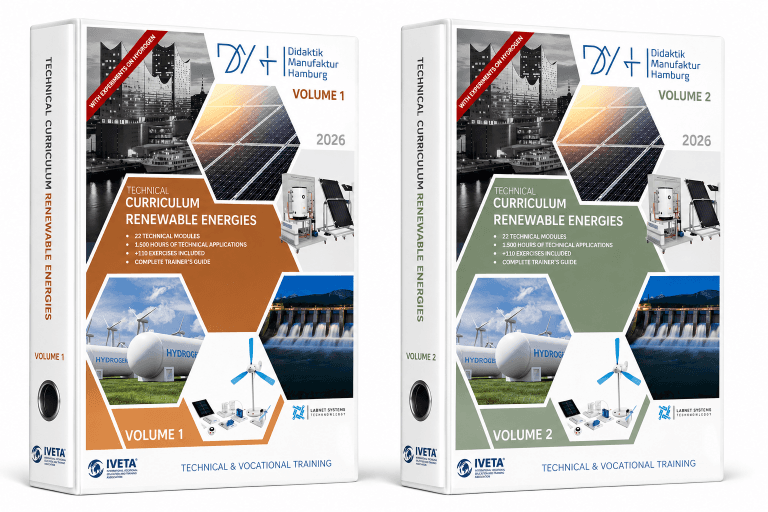

Practical training Curriculum (what is that?)
for RENEWABLE ENERGIES
included as an Integral component of the workshop.
(Each curriculum is individually adapted to the specific requirements of the workshop.)
-> + 1 year step-by-step teaching
-> + 800 hours hands-on working time
-> + 23 modules with exercice instructions
-> + 90 pre-defined practical exercices
-> + 10 individual training equipment KITS
-> + 110 equipment (in the kits)
-> + 20 to 24 apprentices per group (expandable)