Geology Workshop
Geology Workshop
Training and Demonstration System for Geological and Geotechnical Applications

Fully equipped geology workshop for education, practical training, and regional infrastructure development
CONCEPT & PHILOSOPHY
In alignment with our educational and development philosophy, this workshop integrates the fields of petrology, mineralogy, soil mechanics, hydrogeology, cartography, mining, environmental geology, as well as field and laboratory analysis into a highly practice-oriented comprehensive programme.
The training is structured along the complete value chain of applied geology – from initial rock identification and terrain reconnaissance through soil analysis and map interpretation to ground assessment, resource evaluation, and sustainable environmental management.
Participants thereby acquire a coherent, practice-oriented competency profile that enables them and provides the foundation to work as qualified professionals in geological and geotechnical projects.
Hands-On Learning Along the Entire Geological Workflow
With the fully equipped Geology Workshop, participants gain practical experience in all technical and operational steps of applied geology:
Rock and Mineral Identification – Identification, classification, and property analysis of rocks and minerals
Understanding Soil Mechanics – Soil types, bearing capacity, compaction, and ground assessment
Instrument Management – Calibration and operation of microscopes, hand lenses, hardness test kits, and laboratory equipment
Hydrogeology and Water Analysis – Groundwater measurement, sampling, quality determination
Map Interpretation and GIS – Reading geological maps, drawing profiles, applying digital geoinformation systems
Fieldwork and Sampling – Terrain surveys, auger samples, photographic documentation
Environmental and Risk Assessment – Recognising natural hazards, evaluating contaminated sites, applying hazard zone maps
Resource Evaluation and Mining – Deposit types, extraction decisions, critical raw materials
Quality Control and Data Validation – Laboratory protocols, error analysis, result verification
First Field Campaign and Synthesis – Complete terrain survey including report and presentation
Participants learn not only how geology works, but also why certain geological and methodological decisions are critical for long-term safety,
sustainability, and economic viability.
EDUCATIONAL CONTENT
The Significance of Geology for Sustainable Development
Geology is one of the few foundational sciences for sustainable infrastructure that is available locally, independent of technology and season. It enables:
Decentralised Infrastructure Development – Ground assessment for roads, buildings, tunnels, and bridges directly on site
Resource Efficiency – Utilisation of geological data for optimal resource extraction and land use
Circular Economy – Sustainable resource evaluation and responsible resource management
Climate Protection – Precise subsurface analysis for environmental protection, groundwater security, and carbon-neutral planning
EQUIPMENT & LEARNING ENVIRONMENT
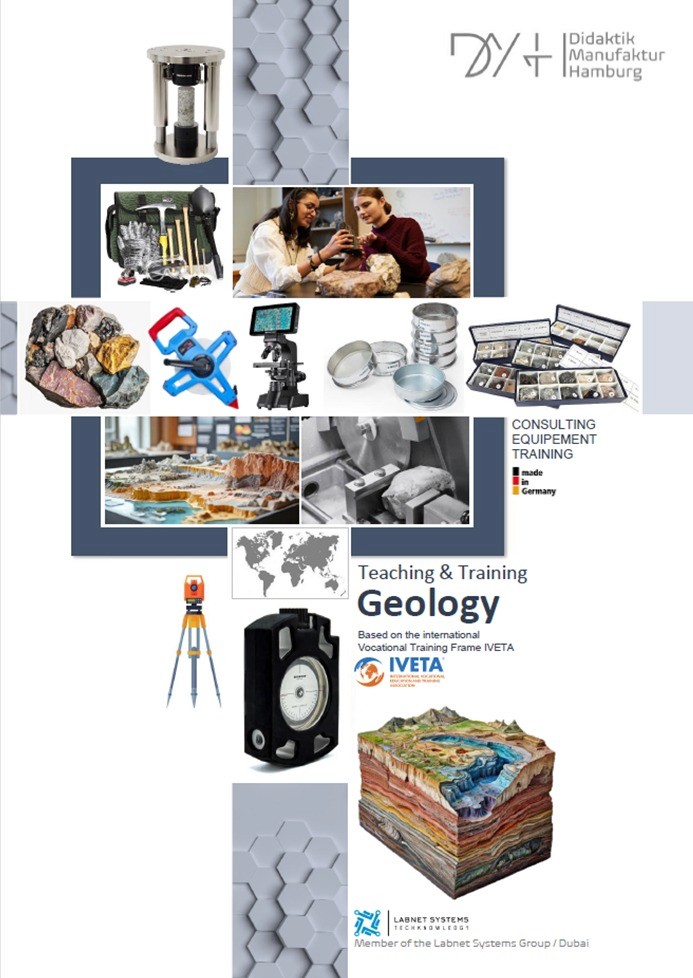
The training system is based on a fully equipped geology classroom and field equipment, consisting of:
Rock and mineral collections with identification keys and Mohs hardness test sets
Stereomicroscopes and polarisation microscope for thin-section and mineral analysis
Soil mechanics laboratory with sieve sets, Proctor test set, precision balances, and drying oven
Hydrogeological equipment with groundwater model, pH meter, conductivity meter, and water quality test kits
GIS software and data processing tools (e.g. QGIS, regional geological maps)
Geological compasses, GPS devices, and field hand lenses for terrain work
Complete field equipment with geological hammers, sample bags, waterproof field notebooks, and documentation material
Safety equipment with hard hats, safety goggles, high-visibility vests, and first aid kits
Consumables and accessories for multiple field and laboratory cycles
Documentation and assessment systems for portfolios and certification
The equipment is designed for groups of approximately 18–24 participants, with parallel work in teams (e.g. rock identification team,
soil analysis team, GIS analysis, field mapping team, documentation).
COMPETENCY FRAMEWORK – PROGRAMME STRUCTURE BY MODULES
The training programme is structured into 10 sequential, progressively building modules:
Module 1 – Introduction: What is Geology? (IG) Fundamental concepts, formation of the Earth, geological timescales.
Module 2 – Petrology & Mineralogy (PM) The three rock types, rock-forming minerals, the rock cycle, identification exercises
Module 3 – Map Reading & Geological Maps (GM) Map structure, legends, dip and strike, drawing profiles, GIS fundamentals
Module 4 – Soil Mechanics & Ground Assessment (SG) Soil types, bearing capacity, compaction, geotechnics, ground investigation reports
Module 5 – Hydrology & Groundwater (HG) Water cycle, aquifers, groundwater measurement, water quality, protection concepts
Module 6 – Construction & Infrastructure (CI) Road construction, tunnel geology, bridge foundations, case studies of real-world projects
Module 7 – Mining & Resource Extraction (MR) Deposit types, extraction methods, critical raw materials, sustainability in mining
Module 8 – Environment & Natural Hazards (EN) Landslides, earthquakes, flooding, contaminated land, hazard zone maps, risk assessment
Module 9 – Practical Fieldwork & Sampling (PF) Terrain survey, rock identification in the field, soil profiles, water sampling, geological report writing
Module 10 – Final Module: Synthesis, Examination & Career Perspectives (SC) Integrated application of all modules, practical and theoretical
examination, certification.
OPPORTUNITIES FOR SELF-FINANCING
Beyond its core function as a training programme, the Geology Workshop offers the opportunity to implement real-world infrastructure
and environmental projects, thereby:
Generating revenue through geological assessments or soil analysis services
Providing communities, construction companies, or mining operations with ground evaluations and maps
Integrating practical project work into the training curriculum
Marketing geological data as a high-value resource, creating additional value
This enables the programme to become partially self-financing in the long term, while simultaneously delivering direct social and economic benefits.
Conclusion
This workshop integrates geology, geotechnics, education, and development impact into a comprehensive, unified concept. It empowers people on the ground to geologically assess sustainable infrastructure, responsibly evaluate resources, and competently appraise environmental risks.
In addition to its purely educational function, the workshop offers an excellent opportunity for self-financing.
Contact us for a tailored proposal – including turnkey solutions, layout planning, and financing options! Your DMH-Team.