Chemistry
Chemistry
Our chemistry experiment kits empower students in primary education and lower secondary education to solve real-world problems through hands-on learning and prepare them for careers in science, technology, and engineering. Chemistry explains the material world, drives innovation, and addresses global challenges such as sustainability, resource conservation, and environmental protection. Chemistry is the foundation of life on Earth.
Each kit contains focused experiments for classroom use up to the end of lower secondary education (Grades 7–10, ≈ ISCED Levels 1 + 2**), with seamless extension into upper secondary education. Based on proven concepts, the sets are suitable for fundamental, safe group experiments.
Our experimental Kits equip students to solve real-world problems through practical, engaging learning, preparing them for careers in science, engineering, and technology. STEM subjects drive innovation, address global challenges, and underpin future careers. Each STEM kit includes a focused set of experiments..
Your benefits at a glance
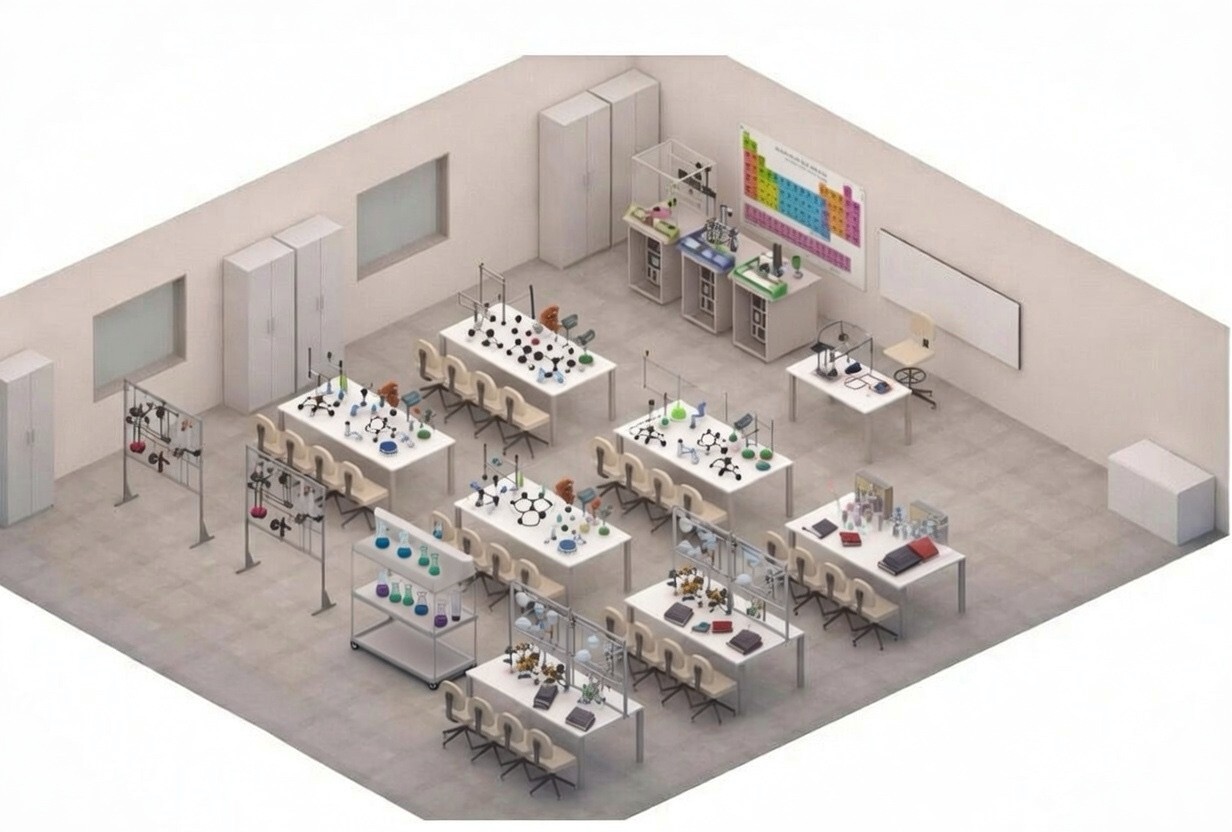
Innovative stackable box system – space-saving, portable, and modularly expandable
Mathematics integration – level-appropriate (basic volume and mass calculations, pH logarithms, concentration calculations, up to graphical analysis)
Alignment with NGSS, national curricula worldwide, and PISA standards
High safety standards and durability, with school-practical handling and hazard warnings for chemicals
Maximum flexibility through separate ordering of power supplies, cables, sensors (e.g., pH, conductivity), titration materials, or heating devices – ideal for budget optimization and existing equipment
Complete materials plus digital resources for engaging and safe instruction
Covered core areas
Organic Chemistry
Physical Chemistry
Technical & Environmental Chemistry
Biochemistry & Food Chemistry
Analytical Fundamentals
Food Chemistry
General & Inorganic Chemistry
Practical experiments make chemistry a tangible, real-word experience
Content of the six boxes:
Box 1: General Chemistry & Properties of Matter (ISCED 1+2)
Topics: Perception, substances in everyday life, separation techniques – sensory perception (seeing, tasting), laboratory equipment and substances in daily life, filtration/distillation, properties of air and gases
(Separate sensors for pH/conductivity & cables required)
Box 2: Inorganic Chemistry & Chemical Reactions (ISCED 1+2)
Topics: Metals/non-metals, gases, oxidation – atomic mass of metals, rusting as combustion, ammonia detection, mineral nutrients in plants
(Separate sensors & power supplies for heating required)
Box 3: Acids, Bases & Salts (ISCED 1+2)
Topics: Acid–base reactions, indicators, pH – neutralization, natural and synthetic indicators, acid strength, titration of simple acids and bases
(Separate pH sensors, burettes & measuring instruments required)
Box 4: Fundamentals of Organic Chemistry (primarily ISCED 2)
Topics: Alcohols, acids, reactions – alkanes (homologous series), carboxylic acids/esters, carbon determination, polymerization (e.g., polystyrene)
(Separate temperature sensors & cables required)
Box 5: Physical & Electrochemistry (primarily ISCED 2)
Topics: Energy, equilibria, galvanic cells – energy in reactions, reaction rates, galvanic elements, voltage measurement
(Separate power supplies, cables & voltage sensors required)
Box 6: Biochemistry, Technical & Environmental Chemistry (primarily ISCED 2)
Topics: Biochemical processes/food chemistry, products, sustainability – vitamin C and protein detection, nitrite in food, industrial products, recycling
(Separate spectroscopy sensors & power supplies required)
Each box is designed for 4–6 students. Build your chemistry laboratory step by step in a clear and structured way.
Start with the fundamentals and expand flexibly.
Your benefits at a glance
The coordinated content is supplied in durable and robust boxes.
All experiments include comprehensive manuals and experiment guides.
One complete set, covering six focus areas, is designed for four to six students.
Mathematics Integration: Mathematical aspects were added to each kit to strengthen the connection between mathematics and the other STEM areas.
Curriculum Review: The experiments were reviewed according to NGSS, German curricula, and PISA standards to ensure they meet the requirements.
Practicality: Each kit contains a manageable number of experiments that can easily be integrated into the school routine.
All Kits are deliverd with complete materials, instructions, and digital resources to make learning engaging and effective.
Content of the Kits
Box 1: Fundamentals of Physics
Topics : Mechanics, Electricity, Optics, Energy
Experiments:
Measurement of acceleration and velocity – Connection to Mathematics: Analysis of motion data (graphs, equations).
Investigation of electromagnetic fields – Connection to Mathematics: Calculation of field strengths and potentials.
Analysis of motion with accelerometers – Connection to Mathematics: Differential calculus (derivatives of position-time functions).
Construction of mechanical systems (e.g., levers, gears) – Connection to Mathematics: Calculation of forces and torques.
Box 2: Chemistry and Materials Science
Topics : Chemical Reactions, Analytical Chemistry, Electrochemistry, Material Properties
Experiments:
Investigation of gas laws – Connection to Mathematics: Ideal gas law (proportionalities).
Titration experiments – Connection to Mathematics: Stoichiometry (calculation of concentrations).
pH measurement and conductivity – Connection to Mathematics: Data analysis (trend lines, correlations).
Acid-base reactions – Connection to Mathematics: pH calculations (logarithms).
Box 3: Biology and Environmental Science
Topics : Microscopy, Genetics, Ecologoy, Substainability Experiments
Experiments:
Investigation of gas laws – Connection to Mathematics: Ideal gas law (proportionalities).
Titration experiments – Connection to Mathematics: Stoichiometry (calculation of concentrations).
pH measurement and conductivity – Connection to Mathematics: Data analysis (trend lines, correlations).
Acid-base reactions – Connection to Mathematics: pH calculations (logarithms).
Box 4: Technology and Robotics
Topics : Programming, Robotics, Renewable Energy, Data Collection Experiments
Experiments:
Construction of electrical circuits – Connection to Mathematics: Ohm's law (calculation of current, voltage, resistance).
Measurement of solar cell power – Connection to Mathematics: Energy conversion efficiency.
Data analysis with sensors – Connection to Mathematics: Data visualization (graphs, charts).
Construction and programming of robots – Connection to Mathematics: Algorithms, coordinate systems.
Box 5: Engineering and Construction
Topics : Mechanics, Electrical Engineering, Construction, Energy Conversion
Experiments:
Construction of electrical circuits – Connection to Mathematics: Ohm's law (calculation of current, voltage, resistance).
Measurement of solar cell power – Connection to Mathematics: Energy conversion efficiency.
Data analysis with sensors – Connection to Mathematics: Data visualization (graphs, charts).
Construction and programming of robots – Connection to Mathematics: Algorithms, coordinate systems.
Box 6 Mathematics and Data Analysis
Topics : Geometry, Algebra, Statistics, Modeling Experiments
Experiments:
Construction of electrical circuits – Connection to Mathematics: Ohm's law (calculation of current, voltage, resistance).
Measurement of solar cell power – Connection to Mathematics: Energy conversion efficiency.
Data analysis with sensors – Connection to Mathematics: Data visualization (graphs, charts).
Construction and programming of robots – Connection to Mathematics: Algorithms, coordinate systems.
Innovative stackable box system – space-saving, portable, and modularly expandable
Mathematics integration – level-appropriate (basic volume and mass calculations, pH logarithms, concentration calculations, up to graphical analysis)
Alignment with NGSS, national curricula worldwide, and PISA standards
High safety standards and durability, with school-practical handling and hazard warnings for chemicals
Maximum flexibility through separate ordering of power supplies, cables, sensors (e.g., pH, conductivity), titration materials, or heating devices – ideal for budget optimization and existing equipment
Complete materials plus digital resources for engaging and safe instruction
Covered core areas
Organic Chemistry
Physical Chemistry
Technical & Environmental Chemistry
Biochemistry & Food Chemistry
Analytical Fundamentals
Food Chemistry
General & Inorganic Chemistry
Practical experiments make chemistry a tangible, real-word experience
Content of the six boxes:
Box 1: General Chemistry & Properties of Matter (ISCED 1+2)
Topics: Perception, substances in everyday life, separation techniques – sensory perception (seeing, tasting), laboratory equipment and substances in daily life, filtration/distillation, properties of air and gases
(Separate sensors for pH/conductivity & cables required)
Box 2: Inorganic Chemistry & Chemical Reactions (ISCED 1+2)
Topics: Metals/non-metals, gases, oxidation – atomic mass of metals, rusting as combustion, ammonia detection, mineral nutrients in plants
(Separate sensors & power supplies for heating required)
Box 3: Acids, Bases & Salts (ISCED 1+2)
Topics: Acid–base reactions, indicators, pH – neutralization, natural and synthetic indicators, acid strength, titration of simple acids and bases
(Separate pH sensors, burettes & measuring instruments required)
Box 4: Fundamentals of Organic Chemistry (primarily ISCED 2)
Topics: Alcohols, acids, reactions – alkanes (homologous series), carboxylic acids/esters, carbon determination, polymerization (e.g., polystyrene)
(Separate temperature sensors & cables required)
Box 5: Physical & Electrochemistry (primarily ISCED 2)
Topics: Energy, equilibria, galvanic cells – energy in reactions, reaction rates, galvanic elements, voltage measurement
(Separate power supplies, cables & voltage sensors required)
Box 6: Biochemistry, Technical & Environmental Chemistry (primarily ISCED 2)
Topics: Biochemical processes/food chemistry, products, sustainability – vitamin C and protein detection, nitrite in food, industrial products, recycling
(Separate spectroscopy sensors & power supplies required)
Each box is designed for 4–6 students. Build your chemistry laboratory step by step in a clear and structured way.
Start with the fundamentals and expand flexibly.
Your benefits at a glance
Contact us for assistance with your project.
Take advantage of our extensive experience and expertise.
We will be happy to send you a personalized quote accompanied by
one or more useful extension options and modules.
Your Didaktik Manufaktur Hamburg Team !

Contact us for assistance with your project.
Take advantage of our extensive experience and expertise.
Your Didaktik Manufaktur Hamburg Team !
We will be happy to send you a personalized quote accompanied by
one or more useful extension options and modules.
Contact us for assistance with your project.
Take advantage of our extensive experience and expertise.
We will be happy to send you a personalized quote accompanied by
one or more useful extension options and modules.
Your Didaktik Manufaktur Hamburg Team !
Downloads
Downloads
Downloads